
Skip to content

24/7 AC Service — Call 956-253-4204

Air Conditioner Repair Laredo TX logo

How Central Air Conditioning Works

Understanding the cooling cycle makes troubleshooting far less mysterious. Once you know which component is responsible for which job, a symptom stops being random and starts pointing somewhere specific.

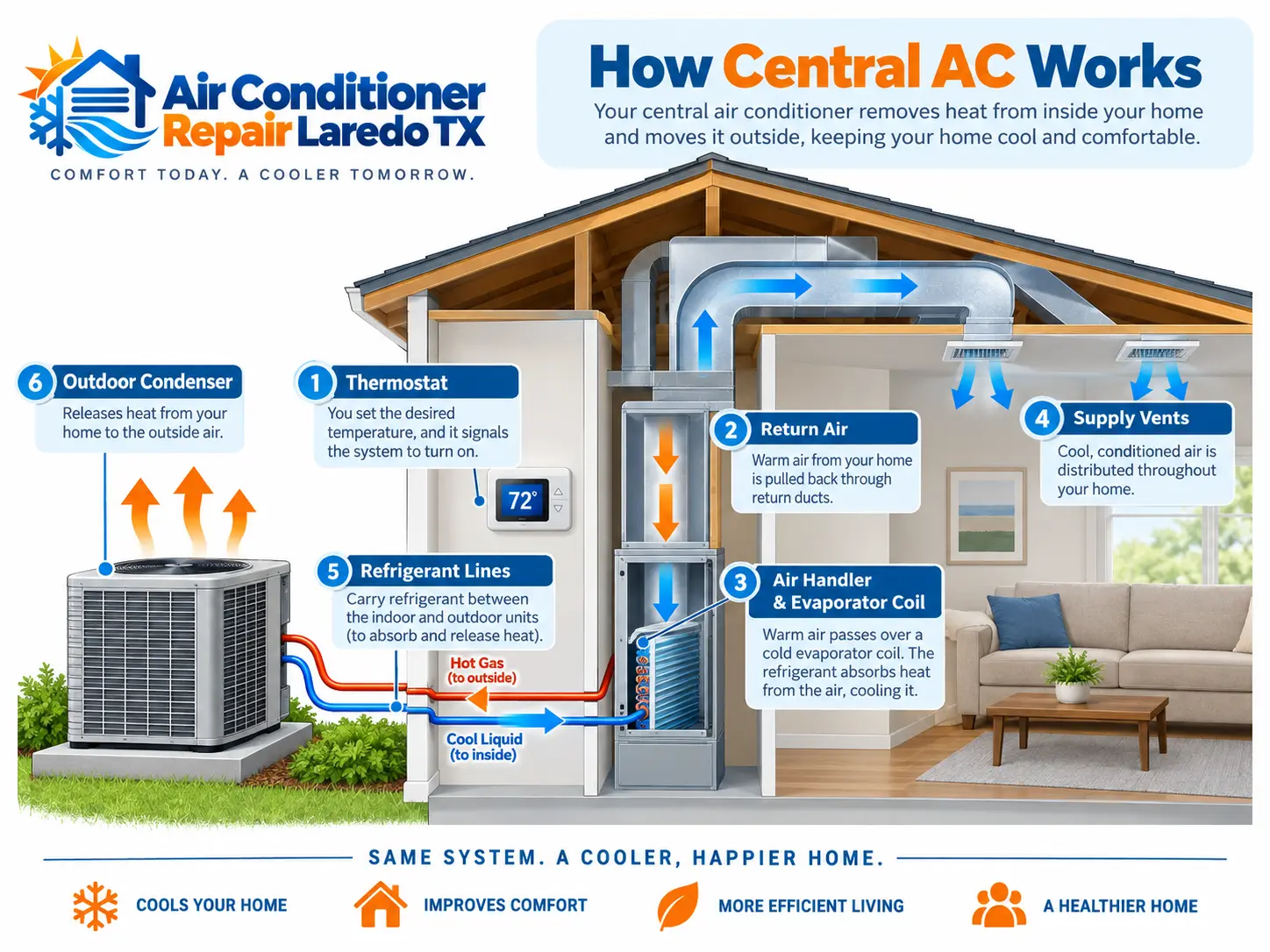
Labeled diagram of a central air conditioning system showing the thermostat, return air, air handler with evaporator coil, supply vents, refrigerant lines and outdoor condenser with compressor

The Cooling Cycle, Step by Step

1. The thermostat calls for cooling

The thermostat compares room temperature to your setpoint. When the room is warmer, it closes a low-voltage circuit that starts the indoor blower and the outdoor unit. A thermostat in direct sun, near a lamp or above a supply register reads the wrong temperature and produces odd cycling.

2. Return air enters the system

Warm indoor air is pulled back through return grilles and ducts, passing through the filter. This is where airflow problems begin: a loaded filter, undersized returns or blocked grilles starve everything downstream.

3. The evaporator coil absorbs heat

Inside the air handler, air crosses the cold evaporator coil. Refrigerant inside the coil evaporates as it absorbs heat, and moisture condenses out of the airstream onto the coil surface and drains away.

4. Cooled air is distributed

The blower pushes the cooled, dehumidified air through supply ducts to registers in each room. Leaky or poorly balanced ductwork shows up here as rooms that never match the thermostat.

5. Refrigerant carries heat outdoors

The insulated suction line carries cool refrigerant vapor to the outdoor unit, where the compressor raises its pressure and temperature so the condenser coil can release that heat to outdoor air.

6. The cycle repeats

High-pressure liquid returns through the smaller line to the metering device, pressure drops, and the refrigerant is cold again as it enters the evaporator. The loop continues until the thermostat is satisfied.

Symptom → likely area

Keeping the cycle healthy

  • Change filters on schedule during peak cooling season.
  • Keep two feet of clearance around the outdoor unit.
  • Rinse condenser coils of dust, cottonwood and grass clippings.
  • Keep the condensate line clear so water leaves the building.
  • Book annual maintenance before summer demand peaks.

How AC Works — Questions

Does an air conditioner create cold air?

No. It moves heat. Refrigerant absorbs heat from indoor air at the evaporator coil and releases it outdoors at the condenser coil. The air feels cold because heat and moisture have been removed from it, not because cold was manufactured.

What does the compressor actually do?

It raises the pressure and temperature of refrigerant vapor so that the outdoor coil can reject heat to outdoor air that is already hot. Without that pressure difference, heat would not flow in the required direction. It is the heart of the system and the most costly component to replace.

Why does my AC remove humidity?

Warm indoor air passing over the cold evaporator coil drops below its dew point, so moisture condenses on the coil surface, collects in the drain pan and leaves through the condensate line. That is why proper run times matter — a system that short cycles cools the air but does not dehumidify well.

What is the refrigerant line set?

Two copper lines between the indoor and outdoor equipment: an insulated larger suction line carrying cool vapor back to the compressor, and a smaller liquid line carrying high-pressure liquid to the metering device. Ice on the larger line is a common visible symptom of airflow or charge problems.

Which component causes which symptom?

Broadly: no start points to electrical parts such as the capacitor, contactor or thermostat circuit; warm air with the outdoor unit running points to the condenser coil, charge or compressor; ice points to airflow or charge; water points to condensate drainage; uneven room temperatures point to ductwork and airflow distribution.

Need AC Help Now? Call 956-253-4204

24/7 AC service is available in Laredo. Describe what your air conditioner is doing and get clear next steps — call anytime, or send a service request with your symptoms.

956-253-4204

Call NowRequest Service