
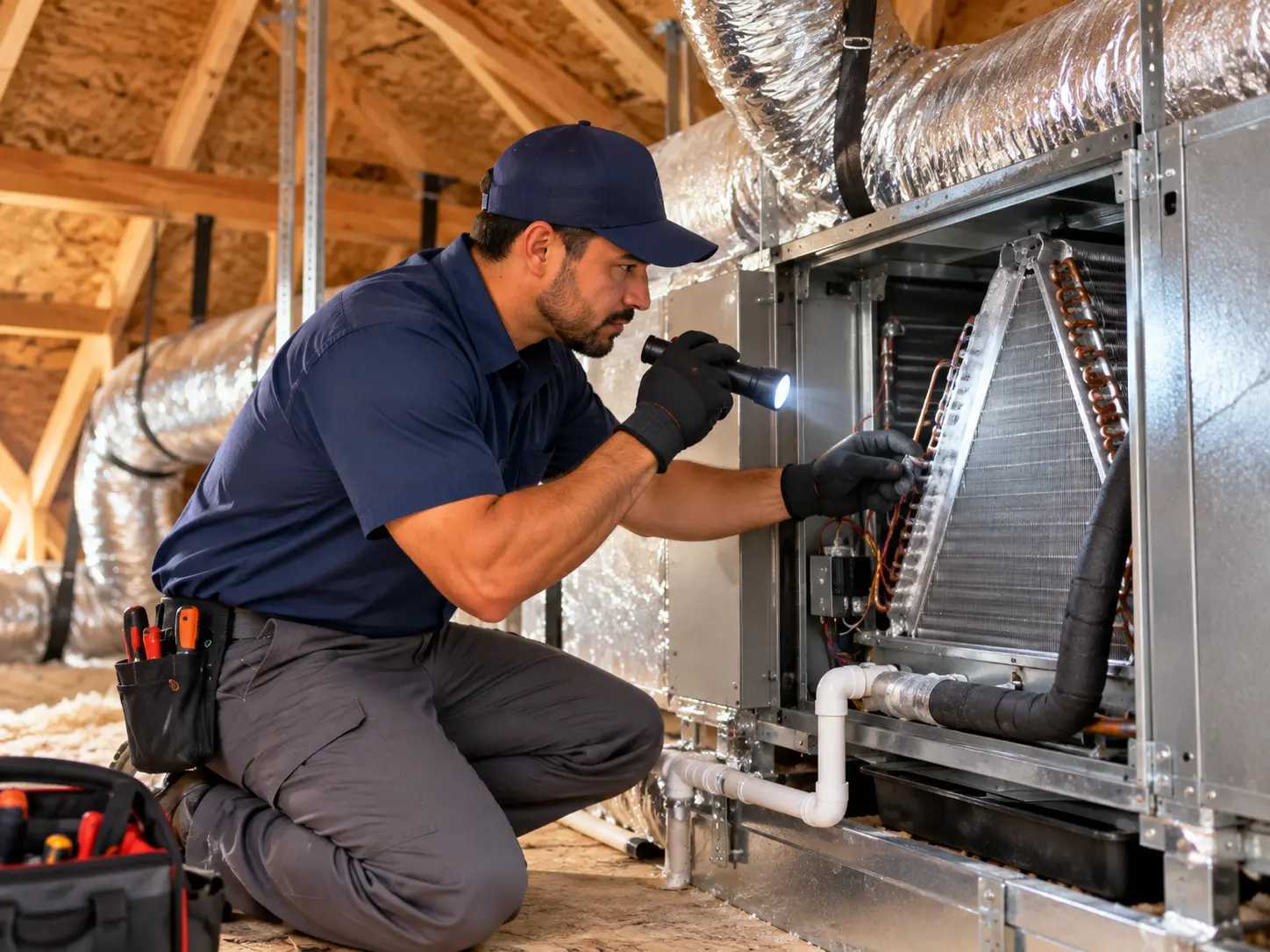
Why coils ice over
The evaporator coil operates just above freezing during normal cooling. It stays there because a steady stream of warm indoor air passes across it. Remove that heat source — a clogged filter, a failing blower, closed vents — and the coil surface drops below freezing. Condensation turns to frost, frost blocks more airflow, and the problem accelerates.
The second path is low refrigerant. A reduced charge lowers the pressure in the coil, which lowers its saturation temperature, and the coil freezes even with perfect airflow. Both paths end in the same block of ice, which is why a homeowner cannot tell them apart by looking.
Signs beyond visible ice
- Airflow at the registers weakens over several hours instead of failing suddenly
- The refrigerant line running to the outdoor unit is frosted rather than cool and sweating
- Water appears near the indoor unit after the system shuts off and melts
- The system runs continuously without satisfying the thermostat
- A hissing or bubbling sound near the indoor coil
Thaw it safely
- Set the thermostat mode to OFF and the fan to ON — moving room air across the coil speeds thawing
- Allow several hours; a heavy freeze can take longer
- Place towels to catch melt water, especially at a closet or attic unit
- Replace the air filter while it thaws
- Never chip, scrape or pry ice off the coil or use a heat gun — coil tubing punctures easily and that turns a repair into a coil replacement
After thawing: what to observe
Once fully thawed, run cooling and watch for an hour. If cooling returns and stays normal with the new filter, restricted airflow was likely the cause and the filter interval should shorten. If ice returns, stop running cooling and request a diagnosis — repeated freezing risks liquid refrigerant reaching the compressor, which causes expensive mechanical damage.
What a technician looks for
- Static pressure and blower performance to quantify airflow
- Coil cleanliness on the entering-air side, which is often invisible without removing a panel
- Refrigerant pressures and superheat to identify undercharge
- Metering device operation, which can restrict flow and mimic low charge
- Duct restrictions, undersized returns and closed dampers
Laredo context
High cooling demand means longer runtimes, and longer runtimes give a marginal system more opportunity to freeze. Dust and fine grit common in the region load filters and coils faster than manufacturers' generic guidance assumes. Checking the filter monthly during peak season is a reasonable habit here even if the packaging says ninety days.
Costs and outcomes
If the cause is airflow, the fix may be as simple as filters and a professional coil cleaning. If the cause is refrigerant loss, the cost depends on where the leak is; an evaporator coil leak is one of the more expensive findings because the coil itself often has to be replaced. Ask for the leak location and the measured charge before approving refrigerant work.