

Air Conditioner Repair Laredo TX
Is your air conditioner blowing warm air, not cooling, refusing to turn on, leaking water, freezing up, short cycling or making an unusual noise? Start with the symptom, understand the likely cause, and request local AC service with clear next steps.
24/7 AC service available in Laredo
Laredo-focused AC help • Clear next steps • Easy service request
What Is Your AC Doing?
Pick the symptom that matches your system and go straight to a page written for that problem.
Laredo-Focused
Guidance written for South Texas cooling demand, where systems run long cycles for months rather than weeks.
Symptom-First Help
Start from what your AC is actually doing — warm air, ice, water, noise — instead of guessing at a part.
Clear Cost Guidance
Educational planning ranges and a calculator so you know roughly where a repair conversation may land.
Easy Phone & Online Request
24/7 AC service available in Laredo — call anytime, or submit a service request with your symptoms and ZIP code.
AC Problems Hit Differently in Laredo Heat
Cooling equipment in South Texas does not get an easy season. The 1991–2020 climate normals show a July normal maximum of approximately 99.9°F for Laredo, which means residential systems run long cooling cycles for months rather than short cycles for weeks. Source: National Weather Service climate normals for Laredo.
That sustained demand is why small weaknesses turn into breakdowns here. A capacitor that has drifted slightly out of spec still works in April and fails in July. A condenser coil coated with dust and grass clippings rejects less heat every afternoon. A filter that would last three months in a mild climate loads faster with regional dust, restricting airflow across the evaporator coil.
Outdoor units also sit in full sun, and the electrical components inside that cabinet are heat-sensitive. Combine that with long runtime and it becomes clear why airflow, coil cleanliness and electrical component condition are the three things worth watching most closely in this region.
None of this means every Laredo home has an aging system or a specific problem. It means the margin for neglect is smaller here than in cooler places. Regular maintenance can be especially valuable in a climate with a long cooling season.
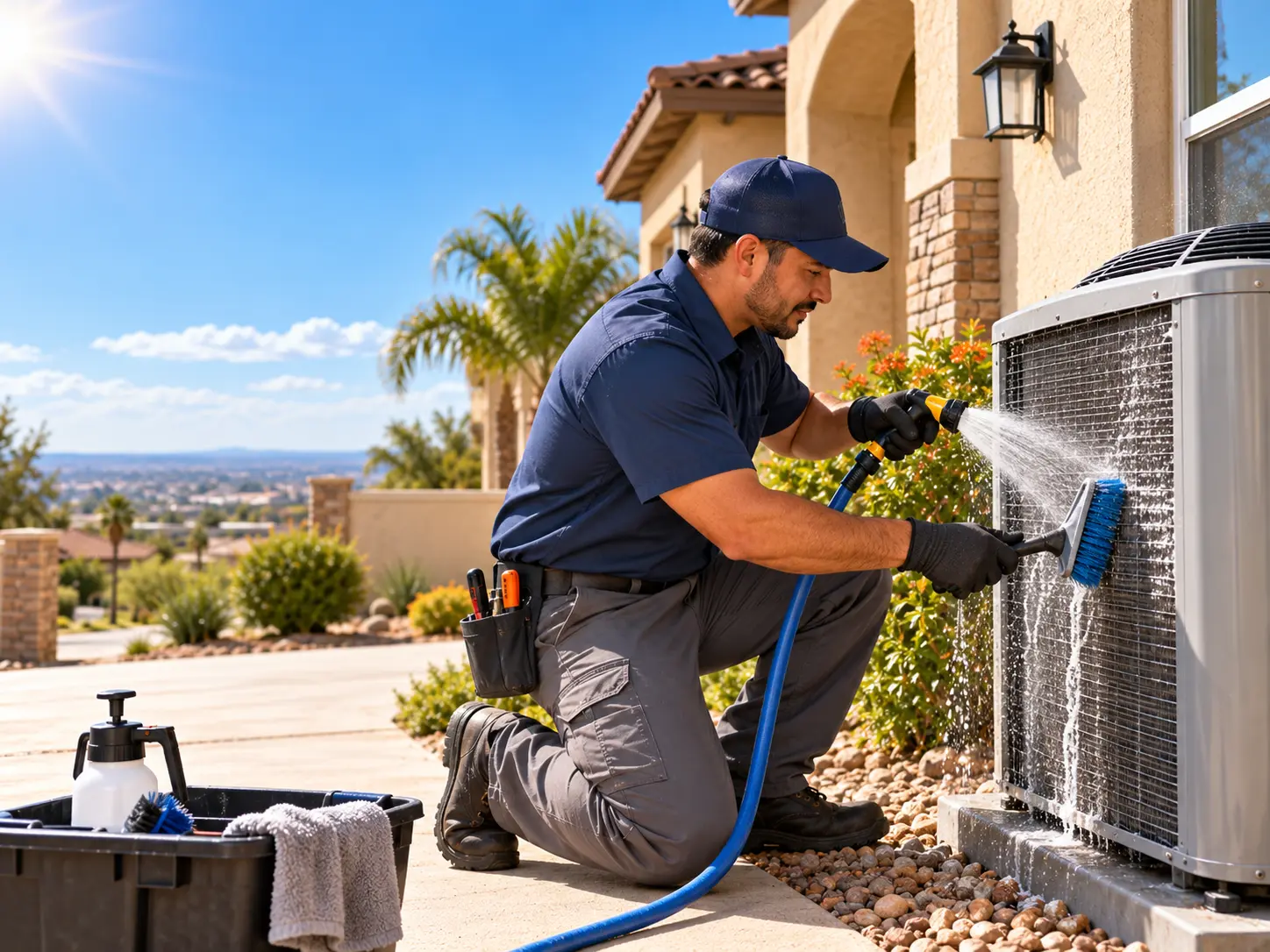
Air Conditioner Repair Services in Laredo
Every page below is written around a specific problem, with causes, safe checks and cost factors.
Why Isn't My AC Working?
Answer two quick questions and get possible causes, safe checks and a clear stopping point.
Step 1 — What is happening?
This tool provides general information and is not a professional diagnosis. Do not open electrical panels, test capacitors, handle refrigerant or bypass safety switches.
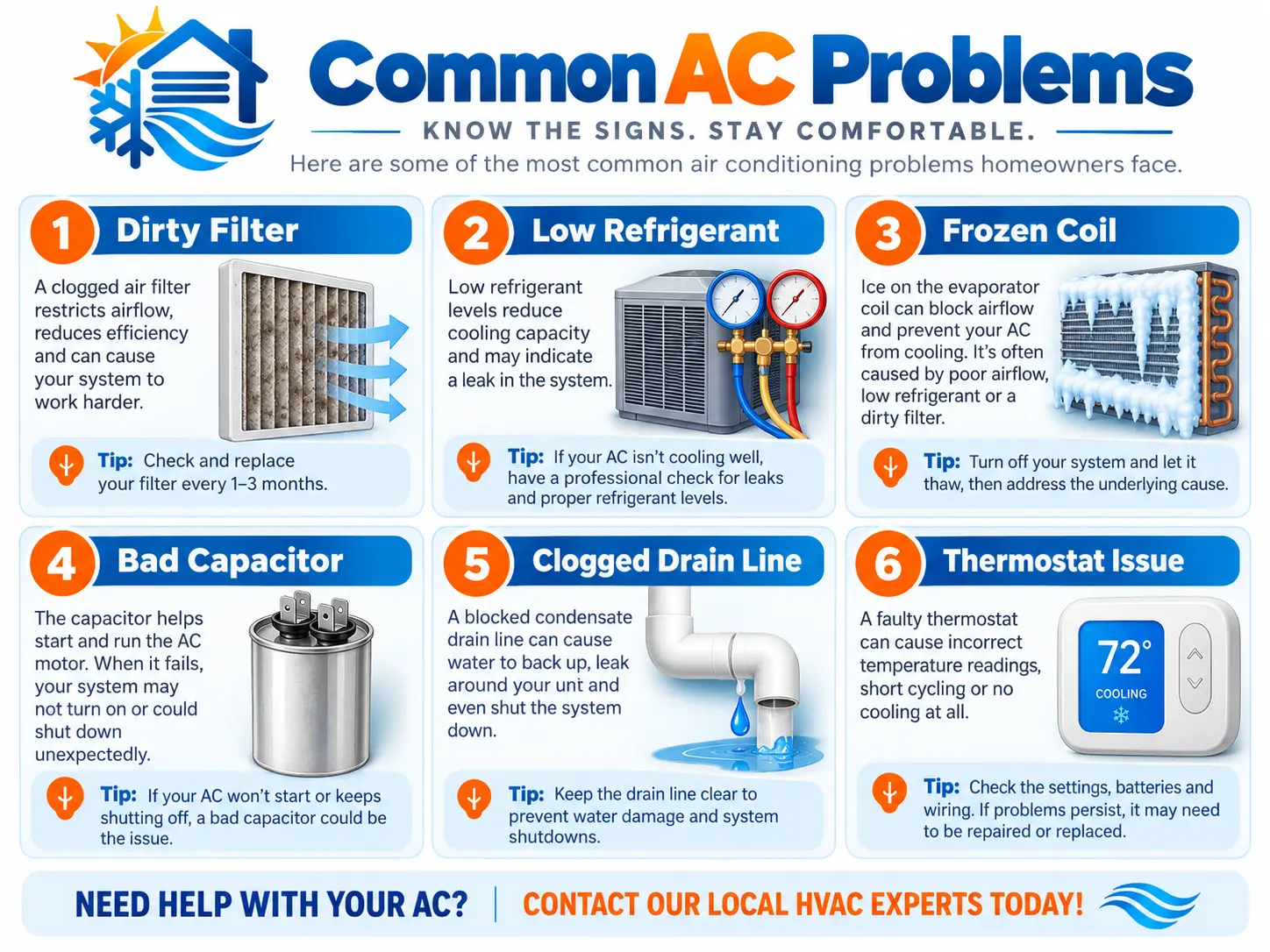
Common AC Problems Homeowners Run Into
Dirty filter
A clogged filter restricts airflow, reduces efficiency and makes the system work harder. Left long enough it causes the evaporator coil to freeze. Check it monthly during peak cooling.
Low refrigerant
Low charge reduces cooling capacity and usually indicates a leak in the sealed system. Refrigerant is not consumed by normal operation, so repeated recharges mean an unrepaired leak.
Frozen coil
Ice on the evaporator coil blocks airflow and prevents cooling. It is usually caused by poor airflow, low refrigerant or a dirty filter. Thaw it safely before restarting.
Bad capacitor
The capacitor helps start and run the AC motors. When it fails the system may hum without starting or shut down unexpectedly in the heat. See capacitor symptoms.
Clogged drain line
A blocked condensate line causes water to back up, leak around the unit and can shut the system down through a float switch. Keep the drain clear to prevent water damage.
Thermostat problems
A faulty thermostat can cause incorrect temperature readings, short cycling or no cooling at all. Check settings and batteries first, then have the control circuit verified.
How AC Service Requests Work
Tell Us What's Happening
Call or submit the service request form.
Confirm Details
Provide location, system type if known and the symptoms you're seeing.
Diagnosis & Options
The service provider handling the request can inspect the system and explain repair options and pricing.
Decide What Works for You
Repairs should proceed only after the homeowner understands and accepts the provider's proposal.
How Much Can AC Repair Cost?
Actual Laredo pricing depends on diagnosis, parts, system type, refrigerant, equipment access and service timing. The figures below are general 2026 national repair-cost benchmarks used as planning examples — they are not local quotes.
| Repair | National planning range |
|---|---|
| HVAC service / diagnostic call | $100 – $250 |
| Capacitor replacement | $100 – $250 |
| Thermostat | $150 – $350 |
| Drain line cleaning | $75 – $200 |
| Refrigerant leak repair | $250 – $1,500 |
| Coil repair or replacement | $600 – $2,400 |
| Compressor | $800 – $3,000 |
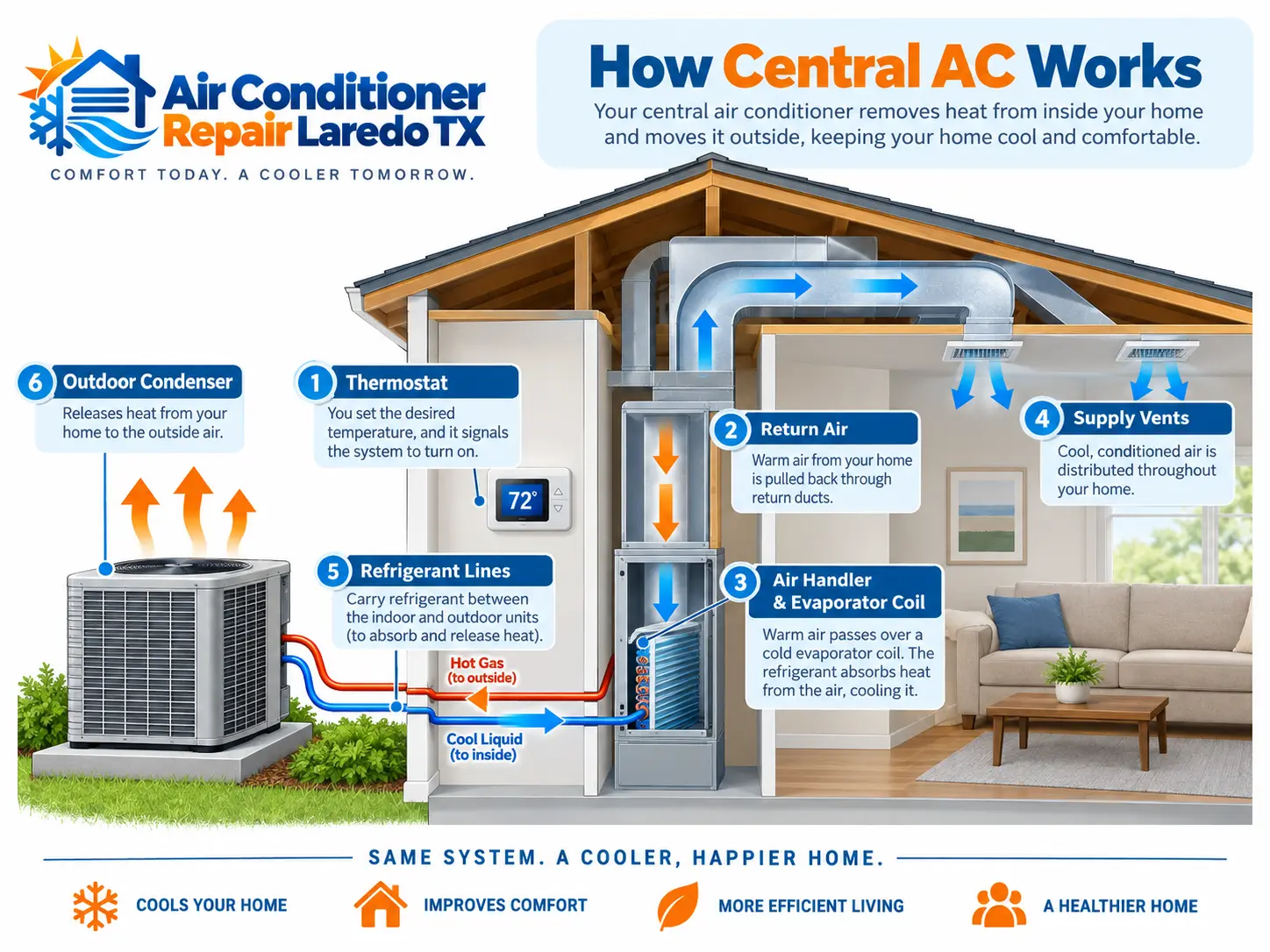
How Central Air Conditioning Works
Your thermostat senses room temperature and signals the system to start. Warm indoor air is pulled back through return air ducts and passes through the filter into the air handler.
Inside, air crosses the cold evaporator coil, where refrigerant absorbs heat and moisture condenses out of the airstream. The cooled air is then pushed through supply ducts and out of the vents in each room.
Refrigerant lines carry that absorbed heat between the indoor and outdoor equipment. At the outdoor condenser, the compressor raises the refrigerant pressure and the coil releases the heat into the outside air. The cycle repeats until the thermostat is satisfied.
Read the full explanation of how central AC works, including which symptoms point to which component.
Repair or Replace?
There is no universal rule. Compare the specific failure against the equipment's history and the installed cost of replacement.
| Repair may make more sense when… | Replacement may deserve consideration when… |
|---|---|
| The problem is isolated to one component | Breakdowns are becoming frequent |
| The system otherwise performs reliably | Major components have failed |
| Repair cost is reasonable for the equipment | System efficiency is clearly poor |
| Parts are available for the model | Equipment is near the end of its useful life |
| Manufacturer parts coverage still applies | Repair cost is approaching a substantial portion of replacement cost |
Laredo Service Areas
Pages written for homeowners across these Laredo areas.
Common Laredo ZIP-code areas include 78040, 78041, 78043, 78045, 78046. Coverage for a specific address depends on the independent provider handling the request. See all service areas.
Laredo AC Repair FAQs
How quickly should I address an AC that is not cooling?
In Laredo summer conditions, quickly. Indoor temperatures rise fast once cooling stops, and several common faults get worse the longer the system keeps running. A frozen coil can send liquid refrigerant back to the compressor. A breaker that trips repeatedly signals an electrical fault. A drain backing up causes ceiling damage within hours. If the house is still tolerable and nothing looks unsafe, you can wait for a scheduled appointment — but if there is ice, water, burning smell or a vulnerable household member, treat it as urgent and call to check current availability.
Why is my AC blowing warm air?
Warm air usually means the outdoor half of the system is not rejecting heat. Check first whether the outdoor unit is running at all. If it is silent, the cause is likely electrical: a tripped breaker, a failed capacitor, or a contactor problem. If it is running and the air is still warm, the likely causes are a low refrigerant charge from a leak, a condenser coil too dirty to release heat, or a compressor that is no longer pumping. Also confirm the thermostat is set to COOL with the fan on AUTO — a fan left on ON circulates warm air between cycles.
Why does my AC keep turning on and off?
That pattern is called short cycling. Common causes include a weakening capacitor, a compressor tripping on thermal overload, a pressure switch opening because the condenser is dirty or the charge is low, a thermostat mounted in direct sun, and loose control wiring. Short cycling is hard on the compressor because startup draws far more current than running does, and it also prevents proper dehumidification. Time a few cycles, note how long the system runs, and share that with the service provider.
Why is ice forming on my AC?
A coil freezes when it runs colder than designed, and that happens for two reasons: not enough warm air moving across it, or not enough refrigerant in it. Airflow restrictions come from clogged filters, closed registers, dirty coils or a weak blower. Low charge comes from a leak. Turn cooling off and set the fan to ON to thaw, replace the filter, and open all vents. Never chip or scrape the ice — coil tubing punctures easily. If ice returns after thawing, stop running the system and request a diagnosis.
Why is my indoor AC unit leaking water?
Air conditioners remove humidity, and that condensate has to drain. Indoor water almost always means it could not. The usual causes are a clogged condensate line, a rusted or cracked drain pan, a disconnected fitting, or a frozen coil that is now melting. Turn cooling off to stop producing more water, soak up standing water before it reaches drywall or flooring, and request service. If the air handler is in the attic, act quickly — water travels through insulation and ceilings before it becomes visible.
Can a dirty filter stop an AC from cooling?
Yes, and it is one of the most common causes. A loaded filter chokes airflow across the evaporator coil. With less warm air passing over it, the coil temperature drops, moisture freezes on the surface, and the ice restricts airflow further. The result is a system that runs constantly and delivers very little. In dusty conditions with long run times, checking the filter monthly during peak cooling season is more reliable than following the interval printed on the package.
What does an AC capacitor do?
The capacitor stores and releases the electrical energy that gets the compressor and fan motors started, and it helps them run efficiently afterward. When capacitance drifts below spec, the outdoor unit may hum without starting, the fan may struggle, or the system may quit during the hottest part of the day and recover once it cools. Capacitors are heat-sensitive, so they fail more often in hot climates. Replacement is inexpensive relative to other repairs — but it is never a DIY task, because capacitors hold a charge even after power is off.
How do I know if refrigerant may be low?
The typical pattern is gradual: cooling that fades over weeks, longer run times, ice on the coil or the copper line, and a system that struggles most on hot afternoons. Refrigerant is not consumed during normal operation, so if the charge is low there is a leak. That is why simply adding refrigerant is a temporary fix. A proper repair locates the leak, repairs it, evacuates the system and recharges to the manufacturer's specified weight. Confirmation requires gauges and measurement, not a homeowner check.
How much does AC repair cost?
It depends on what failed. Using general 2026 national repair-cost benchmarks as planning anchors — not Laredo quotes — a diagnostic visit commonly runs about $100–$250, a capacitor about $100–$250, a thermostat about $150–$350, drain line clearing about $75–$200, refrigerant leak repair roughly $250–$1,500, coil work roughly $600–$2,400 and compressor work roughly $800–$3,000. Your actual price depends on diagnosis, parts, system type, refrigerant, access and service timing. Use the cost guide and calculator on this site to set expectations.
Should I repair or replace my air conditioner?
Look at the specific failure, the repair history, the equipment's remaining useful life and the gap between repair cost and installed replacement cost. A single inexpensive part on a system that has been reliable favors repair. Frequent breakdowns, a failed compressor or leaking evaporator coil on older equipment, poor efficiency, or a repair approaching a substantial share of replacement cost all favor pricing replacement alongside the repair. Avoid treating any single percentage rule as fact — compare real quotes instead.
Can I keep running an AC with ice on it?
No. Running a frozen system keeps returning refrigerant that has not fully evaporated to the compressor, and liquid does not compress. That causes internal damage to the most expensive component in the system. Switch cooling off, set the fan to ON so room air can thaw the coil, and wait until airflow is fully normal before restarting. If ice returns, leave the system off and request a diagnosis rather than repeating the cycle.
What should I check before requesting service?
Confirm the thermostat is set to COOL with the fan on AUTO and a setpoint below room temperature. Replace the filter if it is loaded. Open all supply registers and clear return grilles. Check the breaker panel once for an obviously tripped breaker. Look for ice on the coil or line and water near the indoor unit. Walk outside and note whether the condenser is running, humming or silent. Those observations are exactly what a provider will ask about, and they often shorten the diagnosis.
Need AC Help Now? Call 956-253-4204
24/7 AC service is available in Laredo. Describe what your air conditioner is doing and get clear next steps — call anytime, or send a service request with your symptoms.
956-253-4204